Crypto Exchange vs Wallet: Custody, Risks and Tax in India
Crypto exchange vs wallet explained for Indians: custodial vs self-custody, hot vs cold wallets, FIU rules, 30% tax and 1% TDS, and the risks of each in 2026.
In this article
- The core idea: who holds the private keys?
- Exchange vs wallet at a glance
- Types of wallets
- The regulatory picture in India (as of October 2026)
- Tax: the same rules whether coins sit on an exchange or in a wallet
- Worked example: tax on a crypto sale
- Practical risk checklist (for education, not advice)
- Key takeaways
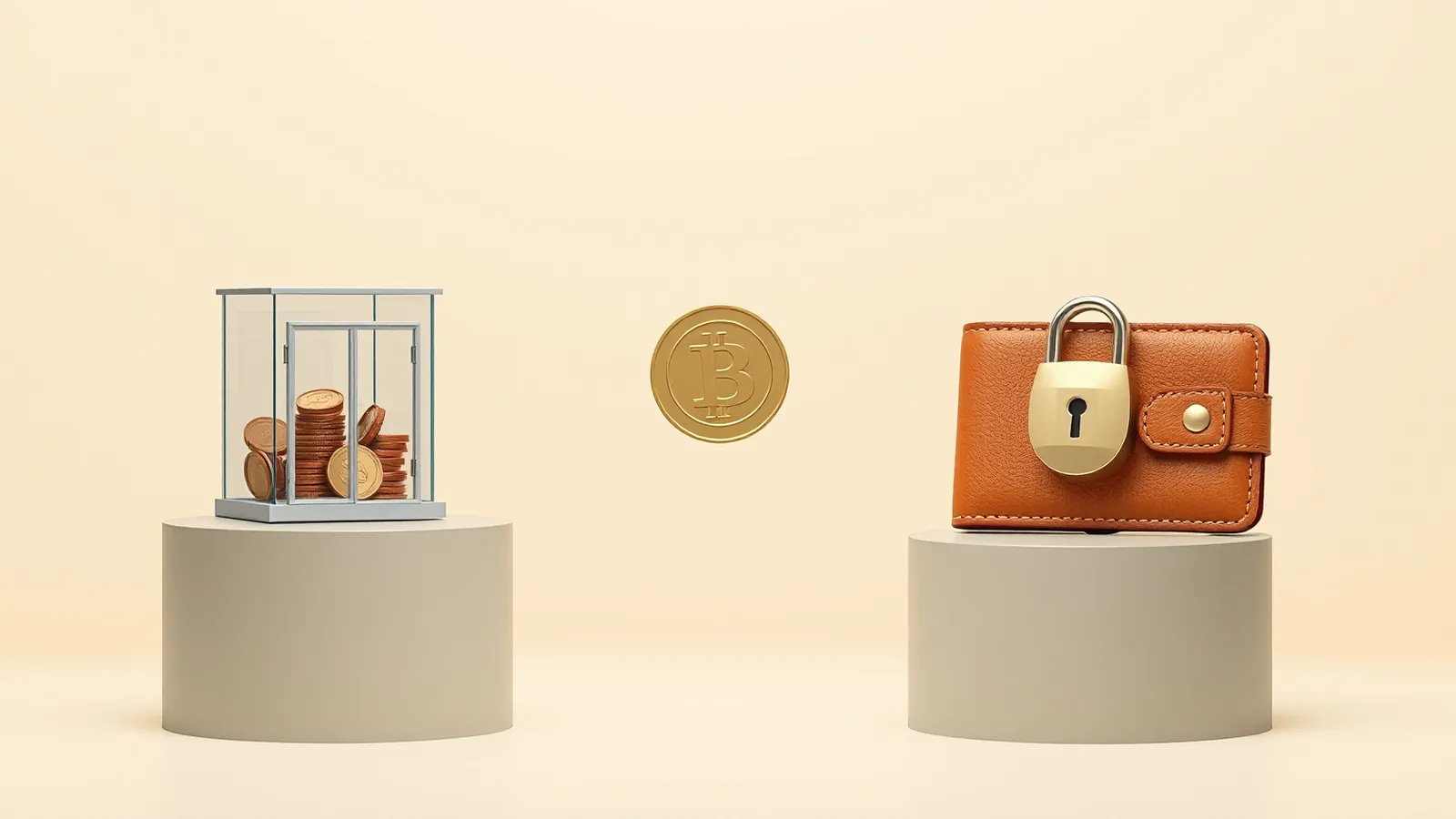
A crypto exchange is a marketplace that also holds your coins for you, while a crypto wallet is a tool for holding the private keys yourself. Leaving crypto on an exchange is convenient but means trusting the platform's security and solvency; moving it to a self-custody wallet removes that platform risk but makes you fully responsible for safeguarding your keys. As of October 2026, the Indian tax treatment is the same either way: 30% on gains plus surcharge and cess, 1% TDS on transfers above thresholds, and no set-off of losses.
This is an educational explainer, not a recommendation to buy, sell or hold any crypto asset. Crypto is not legal tender in India and carries a high risk of loss.
The core idea: who holds the private keys?
Every crypto asset sits on a blockchain at an address. Moving it requires a private key, a long secret number. Whoever controls the key controls the asset.
- Custodial (exchange or custodial app): the platform controls the keys. Your account shows a balance, but technically you hold a claim on the platform.
- Non-custodial (self-custody wallet): you control the keys, usually backed up as a 12 or 24-word seed phrase. The wallet app or device is just an interface.
Exchange vs wallet at a glance
| Aspect | Exchange (custodial) | Self-custody wallet |
|---|---|---|
| Who holds keys | The exchange | You |
| Recovery if you forget a password | Account recovery via KYC | Only via your seed phrase |
| Main risks | Hacks, insolvency, frozen withdrawals, regulatory action against the platform | Losing the seed phrase, phishing, malware, sending to a wrong address |
| Buying and selling with rupees | Yes, via bank or UPI (subject to bank policies) | No; you must move coins to an exchange to sell for rupees |
| KYC | Mandatory under PMLA for FIU-registered exchanges | Not needed for the wallet itself |
| 1% TDS | Deducted by Indian exchange on sale | If you sell peer-to-peer, the buyer may have to deduct it |
| Legal recourse | Against a registered Indian entity, though no specific crypto investor protection law exists | Essentially none if keys are stolen |
Types of wallets
Hot wallets
Software wallets on a phone, browser extension or desktop that stay connected to the internet. Easy to use for frequent transactions, but exposed to malware, fake apps and malicious website approvals.
Cold wallets
Hardware devices or offline setups that keep keys away from the internet. They sign transactions inside the device. Safer against remote hacking, but they cost money, need careful setup and can be lost or damaged; the seed phrase backup remains the single point of failure.
Exchange-linked or "smart" wallets
Some apps blend custody models, for example multi-signature or social recovery setups. Read the documentation to see who can actually move funds.
The regulatory picture in India (as of October 2026)
- Not legal tender. RBI does not recognise crypto as money, and told a parliamentary committee in July 2026 that it does not favour giving virtual digital assets legal recognition at this stage.
- FIU-IND registration. Virtual digital asset service providers, including offshore exchanges serving Indian users, must register with the Financial Intelligence Unit under the Prevention of Money Laundering Act. FIU-IND's updated guidelines in January 2026 reinforced registration as a precondition for operating, and it has acted against non-compliant offshore platforms by blocking their apps and websites.
- No deposit insurance. DICGC insurance covers bank deposits, not crypto held on an exchange.
- No SEBI oversight. Crypto is not a security regulated by SEBI, so SEBI's investor grievance mechanisms do not apply.
Tax: the same rules whether coins sit on an exchange or in a wallet
India taxes virtual digital assets (VDAs) under a special regime introduced in 2022. Budget 2026 retained it, and the Income-tax Act, 2025 carried it forward from 1 April 2026 with renumbered sections (old Section 115BBH for the 30% tax; old Section 194S for TDS, which now sits within the new Act's consolidated TDS provisions in Section 393).
| Rule (FY 2026-27) | Treatment |
|---|---|
| Tax rate on gains | 30% flat, plus surcharge where applicable and 4% cess |
| Deductions | Only cost of acquisition; no deduction for fees, internet or other expenses |
| Losses | Cannot be set off against any other income, including other VDA gains, and cannot be carried forward |
| TDS on transfer | 1% of the sale consideration, above ₹50,000 a year for specified persons (most individuals and HUFs) and ₹10,000 for others |
| Gifts of crypto | Taxable in the hands of the recipient if above the gift exemption limits |
| Reporting | Schedule VDA in the ITR |
Moving coins between your own exchange account and your own wallet is not a transfer to another person and does not by itself trigger tax, but fees paid in crypto for that transfer can be treated as a disposal by some interpretations. Keep transaction hashes, dates and rupee values.
Worked example: tax on a crypto sale
Priya, a salaried individual, buys a token for ₹1,00,000 on an Indian exchange and later moves it to her own wallet. Months later she moves it back and sells it on the same exchange for ₹1,50,000. In the same year, she sells another token at a loss of ₹20,000. Figures are illustrative.
- TDS deducted by exchange: 1% × ₹1,50,000 = ₹1,500
- Gain on first token: ₹1,50,000 − ₹1,00,000 = ₹50,000
- Loss on second token: ignored (cannot be set off)
- Tax: 30% × ₹50,000 = ₹15,000; cess 4% = ₹600 → ₹15,600
- Less TDS credit: ₹15,600 − ₹1,500 = ₹14,100 payable with her return
The wallet transfers in between did not change the tax. Exchange trading fees are also not deductible. To see how the rest of your income is taxed alongside this, use our income tax calculator; note that VDA gains are taxed at the special 30% rate, not at slab rates, and the new-regime rebate (old Section 87A) does not apply to them.
Practical risk checklist (for education, not advice)
If you use an exchange:
- Check that it appears on FIU-IND's list of registered reporting entities.
- Enable two-factor authentication with an authenticator app rather than SMS.
- Understand withdrawal limits and what happens if the platform pauses withdrawals.
- Remember that an exchange balance is a claim on the platform, not the same as holding the asset.
If you use a self-custody wallet:
- Write the seed phrase on paper or metal and store it offline; never photograph it or store it in cloud notes.
- Never share it, including with anyone claiming to be from "support".
- Download wallet apps only from official sources and verify addresses before sending.
- Send a small test transaction before a large one.
- Be cautious with "connect wallet" approvals on unknown websites, which can authorise draining of tokens.
Fraudsters frequently pose as crypto platforms or investment groups. Our guide on how to spot investment scams lists the warning signs. If you are defrauded, report at cybercrime.gov.in or call the 1930 helpline promptly.
For context on how stablecoins behave on exchanges and in wallets, see our explainer on stablecoin depeg risks.
Key takeaways
- An exchange holds your keys for you; a self-custody wallet makes you the only key holder.
- Exchange risk is about the platform (hacks, insolvency, frozen withdrawals); wallet risk is about you (lost seed phrase, phishing, wrong addresses).
- Crypto is not legal tender in India, has no deposit insurance and is not regulated by SEBI; exchanges must register with FIU-IND.
- As of October 2026, gains are taxed at 30% plus surcharge and cess, 1% TDS applies above thresholds, and losses cannot be offset. This applies regardless of where the coins are stored.
- Keep complete records of every transfer, and treat anyone asking for your seed phrase as a scammer.
Frequently asked questions
What is the difference between a crypto exchange and a crypto wallet?
An exchange is a platform where you buy and sell crypto; when you leave coins there, the exchange holds the private keys on your behalf. A self-custody wallet is software or hardware where you hold the private keys yourself, so only you can move the coins, and only you are responsible if the keys are lost.
Is it legal to hold crypto in India?
Holding and trading crypto is not banned in India, and gains are taxed. However, crypto is not legal tender, there is no dedicated investor protection law for it, and RBI has repeatedly warned about its risks. Exchanges serving Indian users must register with FIU-IND under anti-money laundering rules.
How is crypto taxed in India in 2026?
As of October 2026, gains on virtual digital assets are taxed at a flat 30% plus surcharge and 4% cess, with no deduction except the cost of acquisition. Losses cannot be set off against other income or carried forward. A 1% TDS applies on transfers above specified thresholds. Budget 2026 left these rules unchanged.
Is moving crypto from an exchange to my own wallet taxable?
Moving coins between accounts you own is not a sale, so it does not by itself create a gain. Keep records of the transfer, including wallet addresses and transaction hashes, so you can show the cost and holding history when you eventually sell.
What happens if I lose my seed phrase?
For a self-custody wallet, the seed phrase is usually the only way to restore access. If it is lost and the device fails, the coins are generally unrecoverable. If someone else gets the phrase, they can move the coins and there is usually no way to reverse it.
This article is for general education and is not personalised financial, tax or legal advice. Rates and rules are as of 19 Oct 2026; confirm current terms with your lender, AMC or a qualified adviser.