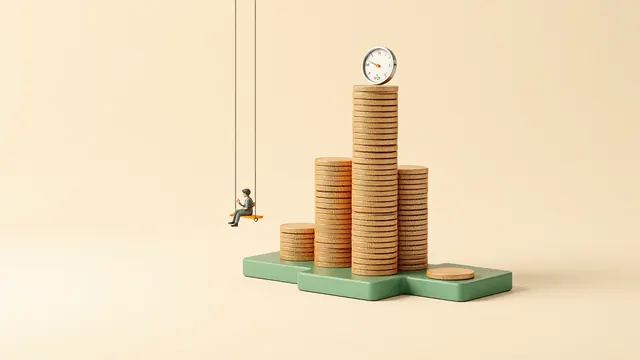
Inflation Impact on Savings: How Rising Prices Eat Your Money
How inflation reduces the value of your savings in India, with worked examples on FDs and savings accounts, real return maths and practical ways to protect money.

In this article
Inflation reduces what your savings can buy. If your money earns 4.5% a year after tax while prices rise 5.5%, your balance grows but its purchasing power falls by roughly 1% every year. The fix is not to avoid safe savings, but to make sure the money meant for long-term goals earns a real (inflation-adjusted) return above zero.
What inflation is and how India measures it
Inflation is the rate at which the general price level rises. In India, the headline measure is the Consumer Price Index (CPI), published monthly by the Ministry of Statistics and Programme Implementation (MoSPI). The CPI series now uses 2024 as its base year.
As of October 2026, the latest data shows:
- Retail (CPI) inflation: 5.54% in September 2026, up from 4.83% in August 2026.
- Food inflation: 7.74% in September 2026.
- RBI's target: 4% CPI inflation, with a tolerance band of 2% to 6%.
- Repo rate: 5.50%, after the RBI raised it by 25 basis points on 7 October 2026.
Your personal inflation can be higher or lower than the headline number. A family that spends heavily on school fees, healthcare or rent often sees costs rise faster than CPI, because those items have historically risen faster than the overall index.
How inflation shrinks money: the core maths
The value of ₹1 after n years of inflation at rate i is:
Real value = Amount ÷ (1 + i)^n
So ₹10 lakh kept idle for 10 years loses purchasing power like this (illustrative):
| Average inflation | What ₹10 lakh buys after 10 years | What ₹10 lakh buys after 20 years |
|---|---|---|
| 4% | ₹6.76 lakh | ₹4.56 lakh |
| 5% | ₹6.14 lakh | ₹3.77 lakh |
| 6% | ₹5.58 lakh | ₹3.12 lakh |
| 7% | ₹5.08 lakh | ₹2.58 lakh |
At 6% inflation, prices roughly double in 12 years. A quick rule of thumb is the Rule of 72: divide 72 by the inflation rate to estimate how many years it takes for prices to double (72 ÷ 6 = 12 years).
Try your own numbers with our inflation calculator.
The future cost of your current lifestyle
Turn the formula around to see what today's expenses will cost later:
Future cost = Today's cost × (1 + i)^n
If your household spends ₹50,000 a month today, at 6% average inflation (illustrative):
- In 10 years: ₹50,000 × 1.7908 = about ₹89,500 a month
- In 20 years: ₹50,000 × 3.2071 = about ₹1,60,357 a month
This is why retirement and child-education targets look so large. The target is not wrong; the rupee simply buys less in the future.
Nominal return vs real return
The interest rate your bank quotes is the nominal return. What matters for your goals is the real return after tax and inflation.
Real return = (1 + post-tax return) ÷ (1 + inflation) − 1
Worked example: ₹10 lakh in a fixed deposit
Assume (illustrative, as of October 2026 conditions):
- FD interest: 6.5% a year
- You are in the 30% slab, so interest is taxed at 30% (ignoring cess and surcharge for simplicity)
- Average inflation: 5.5%
Step 1: Post-tax return = 6.5% × (1 − 0.30) = 4.55%
Step 2: Real return = 1.0455 ÷ 1.055 − 1 = about −0.90% a year
Step 3: After 10 years, assuming the post-tax interest is reinvested:
- FD balance: ₹10,00,000 × 1.0455^10 = about ₹15.60 lakh
- Amount needed just to keep pace with 5.5% inflation: ₹10,00,000 × 1.055^10 = about ₹17.08 lakh
Your balance rose by ₹5.6 lakh, but you are about ₹1.48 lakh short of where you needed to be to keep the same purchasing power. In real terms, the deposit lost value.
For someone with no tax liability, the same FD gives 6.5% against 5.5% inflation, a real return of roughly +0.95%. Tax slab matters a lot. Our comparison of PPF vs FD vs ELSS shows how differently these products are taxed.
Savings accounts fare worse
Many large banks pay 2.5% to 3% a year on regular savings balances. At 2.5% interest and 5.5% inflation, the real return is about −2.8% a year before tax. Money parked for years in a savings account steadily loses value. A savings account is fine for day-to-day spending and part of an emergency fund, not for long-term wealth.
Where common options stand against inflation
Rates below are as of October 2026 and can change. Long-term equity figures are not guaranteed.
| Option | Return (as of Oct 2026) | Tax on returns | Beats inflation? |
|---|---|---|---|
| Savings account | Typically 2.5%-3% at large banks | Taxed at slab | Usually no |
| Bank FD | Varies by bank and tenure | Fully taxed at slab | Depends on slab and inflation |
| PPF | 7.1% (Oct-Dec 2026) | Tax-free | Usually yes, modestly |
| NSC | 7.7% (Oct-Dec 2026) | Interest taxable | Often, before tax |
| Senior Citizens' Savings Scheme | 8.2% (Oct-Dec 2026) | Interest taxable | Often, before tax |
| Gold | Market-linked, volatile | Capital gains tax | Mixed; long cycles of gains and flat periods |
| Diversified equity funds | Market-linked, volatile | Equity LTCG 12.5% above ₹1.25 lakh a year | Historically yes over long periods, not guaranteed |
Small savings scheme rates are reset every quarter by the Ministry of Finance, so check the current rate before investing.
Practical ways to protect savings from inflation
1. Match the product to the time horizon
- Under 1 year (emergency fund, planned expenses): Savings account, sweep-in FD or liquid fund. Safety and access matter more than beating inflation.
- 1 to 5 years (car, wedding, down payment): FDs, RDs, short-duration debt funds, or a mix. Inflation still bites, but equity volatility can hurt more over short periods.
- Over 5-7 years (retirement, child education): Some equity exposure has historically been the main tool for real growth, balanced with safer assets based on your risk tolerance.
2. Plan goals in future rupees
When you set a goal, inflate it first. A ₹20 lakh college cost today becomes about ₹35.8 lakh in 10 years at 6% inflation (illustrative: ₹20 lakh × 1.7908). Then work out the monthly investment needed with a SIP calculator.
3. Look at post-tax returns, not headline rates
A 7% taxable return and a 7.1% tax-free return are very different for someone in the 30% slab. Compare options after tax, and check whether you are in the old or new tax regime.
4. Increase your savings every year
If your income rises with inflation but your SIP or RD amount stays flat, your savings rate falls in real terms. A step-up of 5%-10% a year keeps contributions growing with your income.
5. Do not overcorrect into risky schemes
High inflation is often used as a sales pitch for "guaranteed" high-return schemes. No legitimate product guarantees returns far above government bond yields. Before investing in anything unfamiliar, read our guide on how to spot investment scams.
6. Keep an emergency fund, even though it loses to inflation
Some money will always earn below inflation because it needs to be instantly available. That is the cost of liquidity, and it is worth paying for three to six months of expenses.
How rising inflation affects loans and rates
Inflation also changes borrowing costs. When inflation rises above the RBI's comfort level, the Monetary Policy Committee may raise the repo rate, as it did on 7 October 2026. Floating-rate loans linked to the repo rate can then become costlier. See how the repo rate affects your EMI. Higher rates can also lift FD rates on new deposits, but existing FDs keep their booked rate until maturity.
For borrowers, inflation has one upside: a fixed EMI becomes a smaller share of income as salaries rise over time.
Common mistakes
- Judging investments by balance growth alone. A rising balance can still mean falling purchasing power.
- Ignoring tax. Taxable interest at a high slab can turn a positive nominal return into a negative real one.
- Using today's prices for long-term goals. This leads to under-saving for retirement and education.
- Keeping large idle balances in savings accounts for years "to be safe."
- Chasing unrealistic returns to beat inflation quickly.
Key takeaways
- India's CPI inflation was 5.54% in September 2026 (MoSPI data); the RBI targets 4% within a 2%-6% band.
- Real return = (1 + post-tax return) ÷ (1 + inflation) − 1. If it is negative, your savings are losing purchasing power.
- At 6% inflation, ₹10 lakh buys only about ₹5.58 lakh worth of goods after 10 years (illustrative).
- A 6.5% FD in the 30% slab earns about 4.55% after tax, which is below 5.5% inflation.
- Keep short-term money safe, but plan long-term goals in future rupees and use assets with a realistic chance of real growth.
- Treat any "beat inflation with guaranteed high returns" pitch with suspicion.
Frequently asked questions
How does inflation affect my savings?
Inflation raises prices over time, so the same rupee buys less each year. If your savings earn less after tax than the inflation rate, their real value shrinks even though the balance in your account keeps growing.
What is India's current inflation rate?
Retail inflation measured by the Consumer Price Index was 5.54% in September 2026, according to data released by MoSPI on 12 October 2026. The RBI's target is 4% CPI inflation within a band of 2% to 6%.
What is the real rate of return?
The real rate of return is what you earn after adjusting for inflation. A simple way to estimate it is (1 + post-tax return) divided by (1 + inflation), minus 1. A 4.55% post-tax return with 5.5% inflation gives a real return of about minus 0.9%.
Is a fixed deposit enough to beat inflation?
Sometimes, but not reliably. For someone in a higher tax slab, FD interest after tax is often close to or below inflation. FDs are useful for safety and short-term goals, while long-term goals usually need some assets that can grow faster than inflation.
Which investments have historically beaten inflation in India?
Over long periods, diversified equity and some government-backed schemes such as PPF have generally delivered returns above inflation, but equity returns are volatile and not guaranteed. Past returns do not predict future returns.
This article is for general education and is not personalised financial, tax or legal advice. Rates and rules are as of 19 Oct 2026; confirm current terms with your lender, AMC or a qualified adviser.