Buy vs Lease Business Equipment: A ₹20 Lakh Example
Should you buy or lease business equipment in India? Compare EMIs, lease rent, depreciation, GST credit and resale value on a ₹20 lakh machine.
In this article
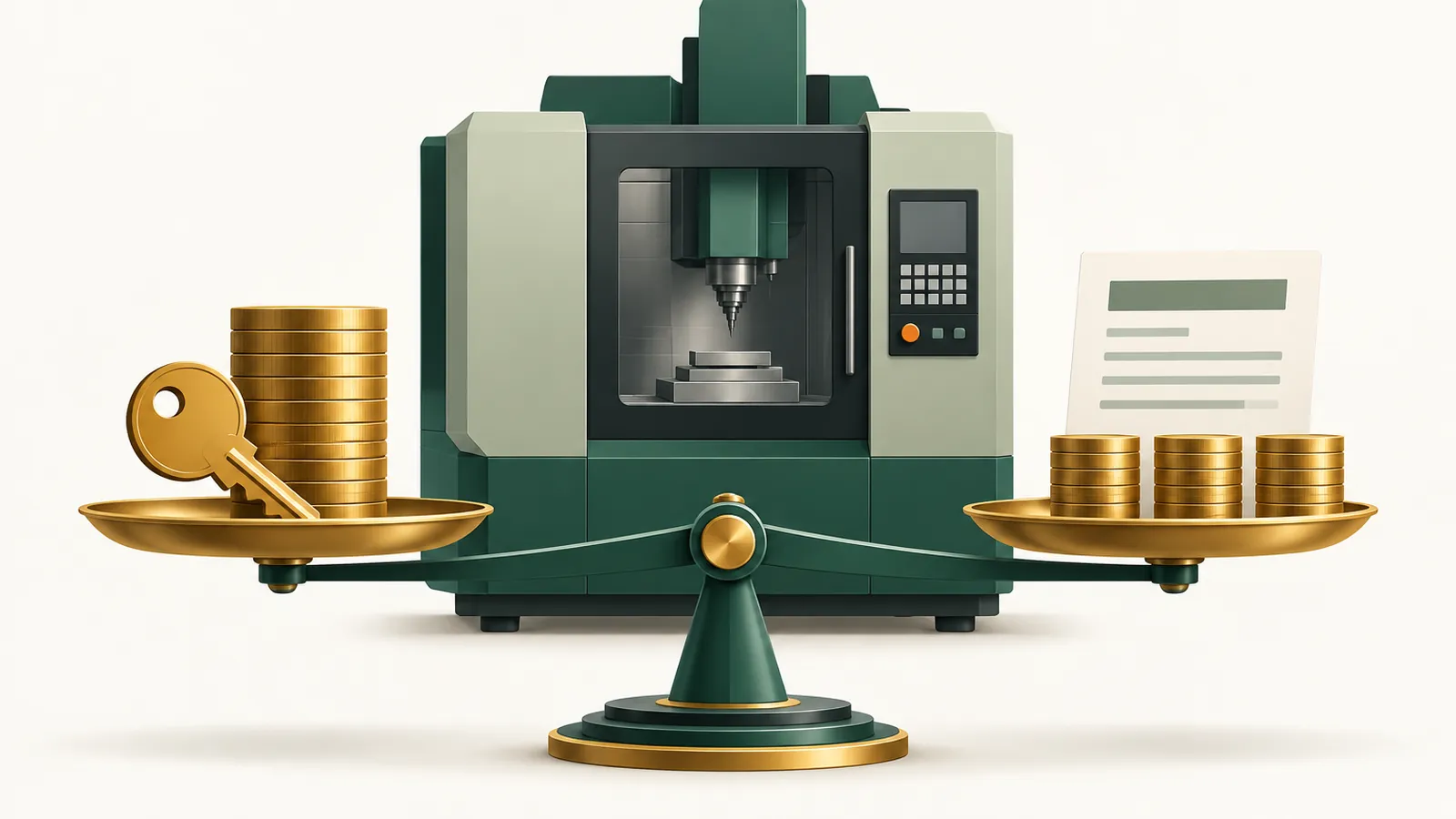
Buy equipment when you will use it for most of its working life and it holds resale value; lease it when it becomes outdated fast, when you cannot spare the down payment, or when a bundled service contract matters more than ownership. The decision turns on four numbers: the after-tax cost of loan EMIs and depreciation, the after-tax cost of lease rent, the resale value you keep only by owning, and the rate at which you discount future payments. The example below compares them for a ₹20 lakh machine.
How buying and leasing differ
| Feature | Buy with a loan | Operating lease |
|---|---|---|
| Upfront cash | Down payment (often 10–25%) plus GST until credit is used | Security deposit and first rentals |
| Monthly outflow | EMI | Lease rent plus GST |
| Ownership | Yours from day one (with lender's charge) | Lessor's |
| Tax deduction | Interest plus depreciation | Lease rentals |
| Resale value | Yours | Lessor's |
| Maintenance | Your responsibility unless an AMC is bought | Often bundled |
| Upgrade flexibility | Must sell and rebuy | Return and lease newer model |
| Effect on borrowing capacity | Adds a term loan to your balance sheet | Lower reported debt for small firms; companies under Ind AS 116 still show a lease liability |
The tax rules that matter
As of October 2026, the Income-tax Act, 2025 applies from 1 April 2026.
- Depreciation on business assets is claimed under Section 33 of the new Act, which replaced old Section 32. General plant and machinery is depreciated at 15% a year on the written-down value (WDV) of the block of assets, and only half the rate is allowed in the first year if the asset is used for less than 180 days. Check your asset class; computers, specified vehicles and energy-saving equipment have different rates.
- Interest on a loan used to buy business equipment is a deductible business expense.
- Lease rent on an operating lease is generally deductible; the lessor claims depreciation.
- GST: if you are registered and the equipment is used for taxable supplies, the GST on the purchase price, or on each lease rental, is generally available as input tax credit. GST therefore usually affects timing rather than total cost. If you cannot claim credit, add GST to the cost of both options.
Worked example: a ₹20 lakh printing machine
All figures are illustrative. A Sivakasi printing firm (a partnership) needs a ₹20,00,000 machine (excluding GST). It expects to use it for five years and is taxed at an illustrative 31.2% (30% plus 4% cess, ignoring surcharge). The machine is installed in April, so full first-year depreciation applies.
Option A: buy with a term loan
- Down payment: 20% = ₹4,00,000
- Loan: ₹16,00,000 at 11% for 60 months
- EMI = ₹16,00,000 × r × (1 + r)^60 ÷ [(1 + r)^60 − 1], where r = 11% ÷ 12 = ₹34,787.88
- Total EMIs: ₹34,787.88 × 60 = ₹20,87,272.61, of which interest is ₹4,87,272.61
- Expected resale value after five years: ₹6,00,000
You can check the EMI with the EMI calculator.
| Year | Interest | Depreciation (15% WDV) | Tax saved at 31.2% |
|---|---|---|---|
| 1 | ₹1,63,446.92 | ₹3,00,000.00 | ₹1,44,595.44 |
| 2 | ₹1,34,053.46 | ₹2,55,000.00 | ₹1,21,384.68 |
| 3 | ₹1,01,258.61 | ₹2,16,750.00 | ₹99,218.69 |
| 4 | ₹64,668.79 | ₹1,84,237.50 | ₹77,658.76 |
| 5 | ₹23,844.84 | ₹1,56,601.88 | ₹56,299.37 |
| Total | ₹4,87,272.61 | ₹11,12,589.38 | ₹4,99,156.94 |
Net cost of buying (not discounted) = down payment + EMIs − tax saved − resale = ₹4,00,000 + ₹20,87,272.61 − ₹4,99,156.94 − ₹6,00,000 = ₹13,88,115.67
Option B: operating lease
- Lease rent: ₹38,000 a month for 60 months (plus GST, claimed as credit)
- Total rent: ₹38,000 × 60 = ₹22,80,000
- Tax saved at 31.2%: ₹7,11,360
- Net cost of leasing (not discounted) = ₹22,80,000 − ₹7,11,360 = ₹15,68,640
- The lessor keeps the machine at the end.
Adjusting for timing
Lease rent is spread evenly, while buying needs ₹4 lakh on day one, so a fair comparison discounts each year's net cash flow. A common choice is the after-tax borrowing rate: 11% × (1 − 0.312) = 7.568%. Treating each year's payments and tax savings as arriving at year-end (a simplification):
| Buy | Lease | |
|---|---|---|
| Net cost, not discounted | ₹13,88,115.67 | ₹15,68,640.00 |
| Present value at 7.568% | ₹12,53,171 | ₹12,67,018 |
Buying is cheaper here, but only by about ₹13,800 in present-value terms. The lease rent at which the two are equal is about ₹37,585 a month, so a modest negotiation on the lease would flip the answer.
The resale assumption decides it
The ₹6 lakh resale value is doing a lot of work. If the machine is obsolete after five years and fetches nothing, the present value of buying rises to about ₹16,69,787, and leasing at ₹38,000 becomes cheaper by roughly ₹4 lakh. Before choosing, ask dealers what five-year-old models of the same machine actually sell for.
Two further simplifications: on sale, the ₹6 lakh is deducted from the block of assets, which reduces future depreciation rather than creating immediate tax in most cases; and maintenance is assumed equal under both options. If the lease includes an annual maintenance contract worth ₹50,000 a year, add that to the buy side.
When leasing usually makes sense
- Fast-changing technology: computers, medical diagnostic equipment, some printing and telecom gear.
- Short or uncertain need: a three-year contract, a pilot project, or a trial of a new product line.
- Tight cash: you would rather keep the down payment for stock and receivables. See the cash conversion cycle for how much working capital your business already ties up.
- Bundled service: uptime guarantees and maintenance are worth more than ownership.
When buying usually makes sense
- Long-life equipment that holds value: standard machine tools, commercial vehicles, generators.
- You will use it for most of its useful life.
- You can get a competitively priced term loan, or a collateral-free loan under the CGTMSE guarantee scheme, whose ceiling was raised to ₹10 crore from 1 April 2025. Compare loan types in business loan and Mudra loan.
- You are confident about the resale market.
Interest rates have turned: the RBI raised the repo rate by 25 basis points to 5.50% on 7 October 2026. Floating-rate equipment loans may get costlier over the term, while most lease rentals are fixed at signing. Factor that into which risk you would rather carry.
Questions to ask before signing a lease
- Is it an operating lease or a finance lease, and who claims depreciation?
- What is the security deposit, and when is it refunded?
- Who pays for insurance, repairs and consumables?
- What are the charges for early termination?
- Is there an option to buy at the end, and at what price?
- Are rentals fixed for the full term, or can they be revised?
- What is the implied interest rate? Ask for it, or estimate it from the rentals and the equipment price.
Key takeaways
- Compare after-tax costs: interest plus depreciation (Section 33 of the Income-tax Act, 2025, old Section 32) for buying, rent for leasing.
- GST is usually creditable either way for a registered business, so it affects cash timing more than cost.
- In the illustrative example, buying a ₹20 lakh machine was cheaper by about ₹13,800 in present value against a ₹38,000 monthly lease.
- If the machine has no resale value after five years, leasing wins by about ₹4 lakh in the same example.
- Lease when technology changes fast, the need is short or cash is tight; buy long-life assets you will use fully.
Frequently asked questions
Is it better to buy or lease equipment for a small business?
Buying is usually cheaper over the full life for equipment that keeps its value and that you will use for many years. Leasing suits equipment that becomes outdated quickly, when you lack the down payment, or when you want maintenance and upgrades bundled in.
Are lease rentals tax-deductible in India?
Rentals under an operating lease for equipment used in your business are generally deductible as a business expense. The owner of the asset, the lessor, claims depreciation. The tax treatment of finance leases can differ, so confirm the structure with your chartered accountant.
Can I claim GST input tax credit on leased equipment?
A GST-registered business can generally claim input tax credit on the GST charged on lease rentals, just as it can on GST paid when buying the equipment, provided the equipment is used for taxable supplies and is not in a blocked category.
What depreciation can I claim if I buy machinery?
Under the Income-tax Act, 2025, depreciation is claimed under Section 33, which replaced old Section 32. General plant and machinery has long been depreciated at 15 percent a year on written-down value, halved in the first year if used for less than 180 days.
How do I compare a lease quote with a loan?
Calculate the after-tax cost of each year's payments for both options, include the resale value you get only by owning, and discount everything at your after-tax borrowing rate. The option with the lower present value is cheaper.
This article is for general education and is not personalised financial, tax or legal advice. Rates and rules are as of 19 Oct 2026; confirm current terms with your lender, AMC or a qualified adviser.