Secured vs Unsecured Credit Card: Cost, Limit and CIBIL
Secured vs unsecured credit card in India compared: approval, limits, fees, interest, rewards and CIBIL impact. See which suits you, with a worked example.
In this article
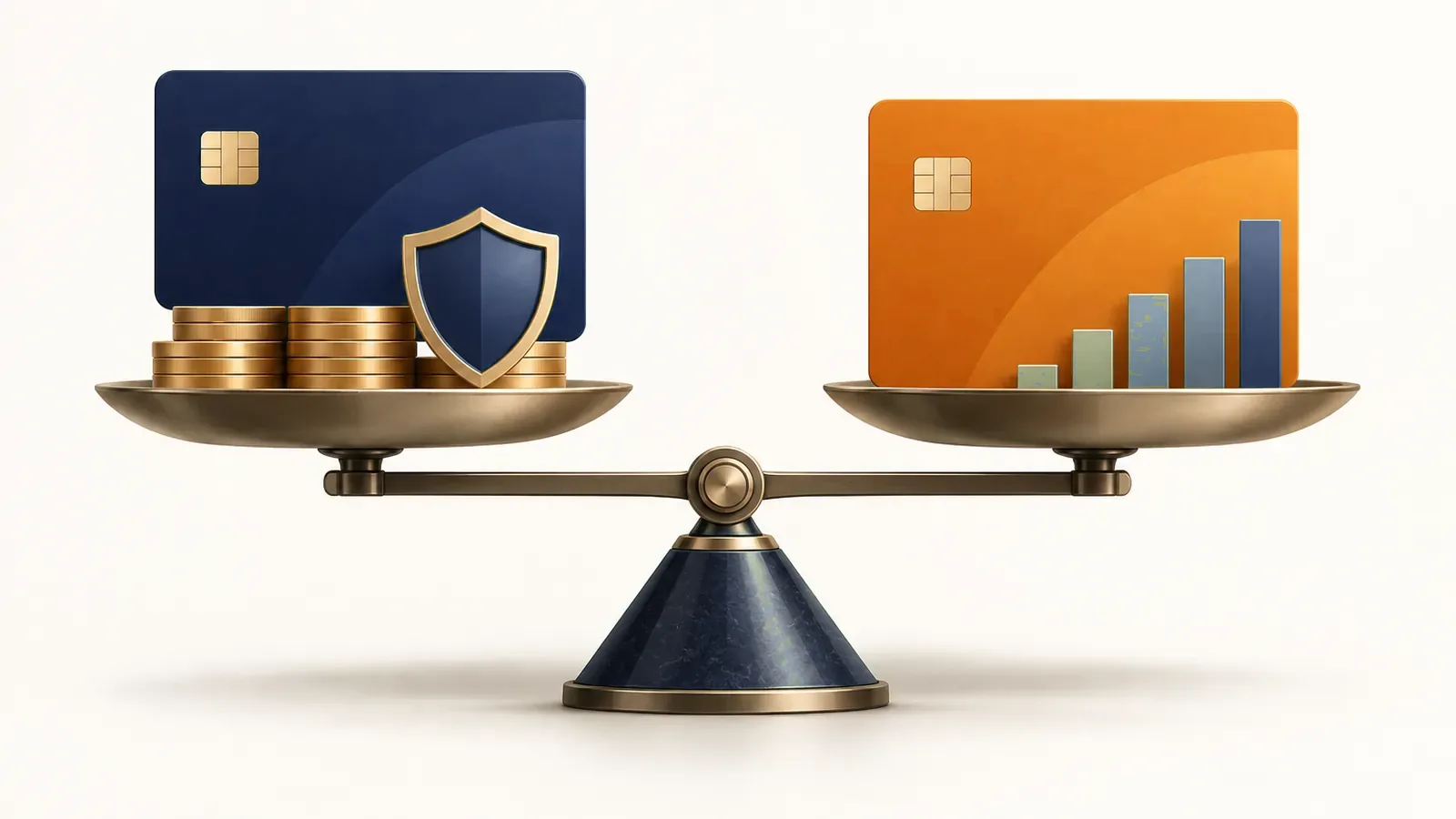
A secured credit card is backed by a fixed deposit and gives a limit of usually 75% to 100% of that deposit, while an unsecured card is backed only by your income and credit record. Secured cards are much easier to get, often without income proof, but cost roughly the same to use and lock up your savings. Both are reported to CIBIL and other bureaus in the same way, so either can build your score if you pay in full and on time.
This comparison is as of October 2026. For a deeper look at FD cards, see our pillar guide to the credit card against FD.
Side-by-side comparison
| Feature | Secured card (against FD) | Unsecured card |
|---|---|---|
| Collateral | FD with the bank, under lien | None |
| Who gets approved | Almost anyone 18+ who can open the FD and complete KYC | Applicants with income proof and an acceptable credit score |
| Income proof | Usually not required | Usually required (salary slips, ITR, bank statements) |
| Credit history needed | No | Usually yes, or a strong banking relationship |
| Credit limit | 75% to 100% of the FD | Based on income and score; can be several times monthly income |
| Interest on unpaid balance | Broadly similar to unsecured cards | Often around 3% to 3.75% a month |
| Fees and GST | Similar; many FD cards are low-fee or free | Ranges from lifetime free to premium annual fees |
| Rewards and perks | Usually basic | From basic to premium (lounges, travel, high rewards) |
| Effect on CIBIL | Reported as a credit card | Reported as a credit card |
| What happens on default | Dues adjusted against FD, plus bureau reporting | Collections, possible legal action, bureau reporting |
| Your money tied up | Yes, for as long as the card is open | No |
Approval: why secured cards say yes more often
With an unsecured card the bank lends you money it may never get back, so it checks your income, existing debts, and CIBIL score. Many issuers look for a score in the 700s or higher for entry cards, though thresholds are internal and not published.
With a secured card the FD covers the bank's risk. That is why these cards are the usual route for:
- Students and first-time borrowers with no credit file. See our first credit card guide.
- Homemakers and freelancers without salary slips.
- People with a low or damaged score who were rejected for unsecured cards.
You still need KYC (PAN and an officially valid document such as Aadhaar), and you must be at least 18.
Limits: fixed by the deposit vs grown over time
A secured card's limit moves only when the deposit moves. A ₹50,000 FD at 90% gives ₹45,000, and that stays the limit until you add more money.
An unsecured card's limit is set by the bank's assessment of your repayment capacity. Banks can offer increases after a good record or a pay rise, though RBI's card directions require your explicit consent before any increase takes effect.
Cost: the deposit is not a discount
A common belief is that a secured card is cheaper because it is backed by your money. It is not, in most cases.
- Interest: charged from the transaction date on unpaid balances once you miss paying in full, at rates similar to unsecured cards. Our guide on how credit card interest works explains the math.
- GST: 18% on interest, fees and charges on both types.
- Late fees: set by each issuer, usually in slabs by the amount due.
- Opportunity cost: the FD earns a fixed rate, but you cannot move that money to a higher-return or more liquid option while the card is open.
On the plus side, many FD cards have no annual fee, and the FD itself earns interest throughout.
Worked example: the same spender with each card
Neha spends ₹15,000 a month on her card. She compares a secured card on a ₹50,000 FD at 90% with an unsecured card with a ₹1,00,000 limit. All figures are illustrative.
Utilisation
- Secured limit: 90% × ₹50,000 = ₹45,000
- Secured utilisation: ₹15,000 ÷ ₹45,000 = 33.3%
- Unsecured utilisation: ₹15,000 ÷ ₹1,00,000 = 15%
On the same spend, the larger limit gives a lower utilisation ratio, which scoring models generally prefer. With the secured card she could pay part of the bill before the statement date to bring the reported balance down.
Cost if she carries ₹10,000 for one month
Assume both cards charge 3.5% a month.
- Interest: ₹10,000 × 3.5% = ₹350
- GST at 18% on interest: ₹350 × 18% = ₹63
- Total: ₹413 on either card
The FD gives no relief on this charge.
What the FD earns
- ₹50,000 × an assumed 6.75% a year = ₹3,375 a year before tax
So the secured card is not costing Neha the FD interest. Its real cost is that ₹50,000 is locked up and the limit is lower. Try your own balance in the credit card interest calculator.
Credit score impact
Credit bureaus do not separate secured and unsecured cards when calculating your score in any way that is publicly documented; both appear as credit card accounts. What matters is:
- Payment history. One missed due date can cost you more points than months of good use earn.
- Utilisation. Lower is better; under about 30% is the common guideline.
- Age of accounts. Keeping your first card open, if it is free, helps over time.
- New enquiries. Several applications in a short period can lower your score.
Safety and fraud protection
Both card types carry the same consumer protections. RBI's card directions apply to secured and unsecured cards alike: a card cannot be issued or its limit raised without your explicit consent, over-limit use needs your opt-in, and a closure request must be honoured within seven working days once dues are paid, or the issuer pays you ₹500 a day. If a fraudulent transaction hits either card, report it to the bank immediately; prompt reporting limits your liability under RBI's customer-liability rules. On a secured card, make sure a disputed amount is not adjusted against your FD while the dispute is open, and ask the bank in writing to hold any such adjustment.
Which one should you pick?
| Your situation | Usually the more practical choice |
|---|---|
| No credit history, no salary slip | Secured card |
| Score below lenders' thresholds after missed payments | Secured card while you rebuild |
| Stable income and a score in the 750s or higher | Unsecured card |
| You want rewards, lounges or travel perks | Unsecured card |
| You want a hard spending cap | Secured card with a small FD |
| You need all your savings liquid | Unsecured card |
Many people use both in sequence: a secured card for 12 to 18 months, then an unsecured card from the same or another bank. Our guide on how to upgrade a secured card to an unsecured card explains the switch.
Key takeaways
- Secured cards need an FD but usually no income proof or credit history; unsecured cards need both.
- Interest, GST and late fees are broadly the same on both, so a secured card is not a cheap way to borrow.
- Both types are reported to bureaus and build your score the same way.
- In our illustrative example, the same ₹15,000 spend was 33.3% utilisation on a ₹45,000 secured limit but 15% on a ₹1 lakh unsecured limit.
- A secured card is a starting point; most people move to an unsecured card after a clean 12 to 18 months.
Frequently asked questions
What is the difference between a secured and unsecured credit card?
A secured card is backed by a fixed deposit that the bank holds under lien, and its limit is a percentage of that deposit. An unsecured card has no collateral; the bank sets the limit from your income, credit score and repayment history.
Is a secured credit card bad for my credit score?
No. Secured cards are reported to credit bureaus as credit card accounts, so on-time payments build your score just as with an unsecured card. Late payments hurt it the same way too.
Do secured credit cards charge lower interest?
Usually not by much. Interest on unpaid balances, late fees and 18% GST on charges are broadly similar to unsecured cards, though some FD cards list a lower starting rate. Always check the card's MITC document.
Can I convert a secured credit card into an unsecured one?
Sometimes. Many banks review secured cardholders after 6 to 18 months of on-time payments and may offer an unsecured card, but this is at the bank's discretion and not guaranteed.
Which is easier to get, a secured or unsecured credit card?
A secured card is far easier, because the deposit removes most of the bank's risk. Banks often issue one without income proof or a credit history, while unsecured cards need income documents and usually a good CIBIL score.
This article is for general education and is not personalised financial, tax or legal advice. Rates and rules are as of 21 Oct 2026; confirm current terms with your lender, AMC or a qualified adviser.